5.9 - Service-Practice Requirements and Exceptions
Module: Recovery Recycling Reclaiming Evacuation and Dehydration
Regulatory verification date: August 9, 2026
Primary authority: 40 CFR §§ 82.152 and 82.156 and current EPA Section 608 service-practice guidance
Course role: Establishes the current federal refrigerant-removal levels required before covered appliances are opened or disposed of and explains the limited exceptions for non-major work, leaking equipment, oil changes, and disposal
Learning Objectives
After completing this section, a student should be able to:
- Explain when Section 608 requires refrigerant to be evacuated from an appliance before maintenance, service, repair, or disposal.
- Select the current required evacuation level from the Section 608 table using appliance pressure category, full charge, and recovery-equipment manufacture or import date.
- Distinguish the current Table 1 requirements from the separate Type I small-appliance recovery requirements.
- Define major maintenance, service, or repair and explain why the distinction matters when applying the limited non-major-repair exception.
- Apply the current exception for an appliance that cannot reach the prescribed evacuation level because of a leak or because further evacuation would substantially contaminate the recovered refrigerant.
- Explain how leaking and non-leaking components should be isolated and evacuated when the leak exception applies.
- Apply the special pressure requirement for changing refrigerant oil and explain why refrigerant dissolved in oil must be recovered.
- Explain how Section 608 service-practice requirements apply during disposal and identify the special disposal recordkeeping requirement for certain appliances.
Introduction
Sections 5.1 through 5.8 developed the technical process of:
recovering refrigerant
→ selecting recovery equipment
→ preparing the recovery setup
→ using recovery cylinders
→ evacuating and dehydrating a system
→ evaluating a standing vacuum
This section now answers a different question:
How far must refrigerant be removed before a covered appliance or component is opened or disposed of under current Section 608 service-practice requirements?
The answer is not one universal vacuum value.
The required endpoint depends on several conditions, including:
- Appliance category.
- Pressure classification.
- Appliance full charge.
- Whether the appliance is a small appliance.
- Whether the recovery or recycling equipment was manufactured or imported before or on/after November 15, 1993.
- Whether the work is major or non-major.
- Whether a leak prevents the prescribed evacuation level from being reached.
- Whether the work involves an oil change.
- Whether the appliance is being serviced or disposed of.
Section 608 therefore requires a technician to identify the correct regulatory condition first, then apply the correct recovery endpoint.
This section uses the current EPA evacuation table and current 40 CFR § 82.156 as the controlling sources.
Key Concepts
1. Section 608 Evacuation Is a Refrigerant-Removal Requirement
In Section 608 regulatory language, evacuation can refer to removing refrigerant from an appliance to a specified recovery endpoint before the appliance is opened or disposed of.
This is different from the service use of deep evacuation discussed in Sections 5.7 and 5.8.
The distinction is:
| Term in This Course | Main Purpose | Typical Measurement |
|---|---|---|
| Section 608 refrigerant evacuation / recovery endpoint | Remove refrigerant before opening or disposal | in. Hg vacuum, mm Hg absolute, percentage recovered, or other regulatory endpoint |
| Deep evacuation / dehydration | Remove air and water vapor after refrigerant recovery and repair | Microns absolute |
A technician must not confuse:
EPA-required refrigerant recovery level
with:
manufacturer-specified deep-vacuum dehydration target
A system may satisfy the Section 608 refrigerant-removal requirement and still require additional deep evacuation and dehydration before it is charged and returned to service.
2. Before Opening or Disposal, Recover Refrigerant First
For appliances covered by 40 CFR § 82.156(a), technicians must remove refrigerant to the applicable level before:
- Opening the appliance for maintenance.
- Opening the appliance for service.
- Opening the appliance for repair.
- Disposing of the appliance.
The current regulation requires removal of the refrigerant, including liquid refrigerant, using applicable recovery and/or recycling equipment unless a specific exception applies.
The technician must verify that the required level has been reached before the appliance or affected part is opened.
3. The Entire Appliance Does Not Always Need to Be Evacuated
A technician may evacuate:
the entire appliance
or:
only the part to be serviced
when refrigerant in the affected part can be isolated to a system receiver.
This can reduce:
- Recovery time.
- Refrigerant handling.
- Refrigerant transfer.
- Potential emissions.
However, the portion that will actually be opened must still reach the applicable required evacuation level unless a specific exception applies.
4. The Current Table Excludes Small Appliances, MVACs, and MVAC-Like Appliances
The current Table 1 in 40 CFR § 82.156 applies to appliances except:
- Small appliances.
- Motor-vehicle air conditioners (MVACs).
- MVAC-like appliances.
This distinction is important because a small appliance is not defined by charge alone.
A small appliance must be:
- Fully manufactured at a factory.
- Charged at a factory.
- Hermetically sealed at a factory.
- Charged with 5 lb or less of refrigerant.
Therefore:
5 lb or less
does not automatically mean:
small appliance
A field-connected appliance with 5 lb or less may still be subject to the main evacuation table if it does not meet the small-appliance definition.
See Section 1.3 - Certification Types for the complete small-appliance definition.
5. Small Appliances Use a Different Recovery Rule
Before opening or disposing of a small appliance, the applicable Type I recovery requirement is based on:
- Recovery-equipment manufacture date.
- Whether the appliance compressor is functional.
The current federal requirements are summarized as:
| Condition | Required Recovery |
|---|---|
| Recovery equipment manufactured before November 15, 1993 | 80% |
| Recovery equipment manufactured on or after November 15, 1993 and compressor functional | 90% |
| Recovery equipment manufactured on or after November 15, 1993 and compressor not functional | 80% |
| Alternative method | Evacuate the small appliance to 4 in. Hg vacuum |
These requirements were introduced in Section 5.3 and are developed in detail in Module 7.
Exam trap: Do not apply the main high-/medium-/low-pressure Table 1 directly to a qualifying small appliance.
6. Main Evacuation Table Uses Three Controlling Inputs
For an appliance subject to Table 1, identify:
- Appliance pressure category.
- Appliance full charge, where the table distinguishes below 200 lb from 200 lb or more.
- Recovery/recycling equipment manufacture or import date relative to November 15, 1993.
The relevant pressure categories are:
- Very high pressure.
- High pressure.
- Medium pressure.
- Low pressure.
The charge threshold is:
less than 200 lb
versus:
200 lb or more
where specified.
The equipment-date distinction is:
manufactured or imported before November 15, 1993
versus:
manufactured or imported on or after November 15, 1993
Important: The 1993 date in this table refers to the recovery or recycling equipment, not the manufacture date of the refrigeration appliance.
Technical and Regulatory Details
1. Current Required Levels of Evacuation
The current Section 608 evacuation table is reproduced below for course use.
| Type of Appliance | Recovery/Recycling Equipment Manufactured or Imported Before Nov. 15, 1993 | Recovery/Recycling Equipment Manufactured or Imported On or After Nov. 15, 1993 |
|---|---|---|
| Very-high-pressure appliance | 0 in. Hg vacuum | 0 in. Hg vacuum |
| High-pressure appliance or isolated component, full charge less than 200 lb | 0 in. Hg vacuum | 0 in. Hg vacuum |
| High-pressure appliance or isolated component, full charge 200 lb or more | 4 in. Hg vacuum | 10 in. Hg vacuum |
| Medium-pressure appliance or isolated component, full charge less than 200 lb | 4 in. Hg vacuum | 10 in. Hg vacuum |
| Medium-pressure appliance or isolated component, full charge 200 lb or more | 4 in. Hg vacuum | 15 in. Hg vacuum |
| Low-pressure appliance | 25 mm Hg absolute | 25 mm Hg absolute |
For the inches-of-mercury rows, the regulation defines the vacuum relative to a standard atmospheric pressure of 29.9 in. Hg.
2. Read the Vacuum Units Carefully
The table uses two different pressure conventions:
inches of Hg vacuum
and:
mm Hg absolute
They are not the same kind of measurement.
Inches of Hg Vacuum
For the high-, medium-, and very-high-pressure rows:
0 in. Hg vacuummeans essentially no vacuum below atmospheric pressure.- A larger inches-of-Hg-vacuum value represents a deeper vacuum.
Therefore:
10 in. Hg vacuum
is a deeper vacuum than:
4 in. Hg vacuum
Millimeters of Hg Absolute
For low-pressure appliances:
- The requirement is 25 mm Hg absolute.
- This is an absolute-pressure value.
- Lower absolute pressure means a deeper vacuum.
Do not compare the number 25 directly with 4, 10, or 15 without recognizing that the units and reference points are different.
See Section 4.6 - Gauge Pressure Absolute Pressure and Vacuum for the pressure-reference explanation.
3. Zero Inches of Hg Vacuum Is Not a Deep Vacuum
A common exam error is to interpret:
0 in. Hg vacuum
as:
perfect vacuum
That is incorrect.
The table’s inches-of-Hg-vacuum scale is referenced to atmospheric pressure.
Therefore:
0 in. Hg vacuum
→ approximately atmospheric pressure
It does not mean:
0 absolute pressure
This distinction is especially important for:
- Very-high-pressure appliances.
- High-pressure appliances with a full charge below 200 lb.
- Certain limited service-practice exceptions.
4. Table Selection Examples
Example A — High-Pressure Appliance Below 200 lb
A residential or commercial high-pressure appliance has:
Full charge = 35 lb
and the technician uses recovery equipment manufactured after November 15, 1993.
Apply:
High pressure
+
full charge < 200 lb
+
post-1993 equipment
Required level:
0 in. Hg vacuum
Example B — High-Pressure Appliance at or Above 200 lb
A high-pressure appliance has:
Full charge = 250 lb
and post-1993 recovery equipment is used.
Apply:
High pressure
+
full charge ≥ 200 lb
+
post-1993 equipment
Required level:
10 in. Hg vacuum
Example C — Medium-Pressure Appliance at or Above 200 lb
A medium-pressure appliance has:
Full charge = 300 lb
and post-1993 recovery equipment is used.
Required level:
15 in. Hg vacuum
Example D — Low-Pressure Appliance
A low-pressure appliance is subject to:
25 mm Hg absolute
for either pre-1993 or post-1993 recovery/recycling equipment under the current table.
5. Major Maintenance, Service, or Repair
The current federal definition of major maintenance, service, or repair includes work involving removal of any or all of the following components:
- Compressor.
- Condenser.
- Evaporator.
- Auxiliary heat-exchange coil.
The definition also includes maintenance, service, or repair that uncovers an opening of more than:
4 square inches of flow area
for more than:
15 minutes
The major/non-major distinction matters because the limited non-major service exception described below is not available for work that meets the major-work definition.
6. Major Versus Non-Major Decision
For this course, use the following decision process:
Does the work remove a compressor,
condenser, evaporator,
or auxiliary heat-exchange coil?
If yes:
Major maintenance / service / repair
If no, ask:
Will the work uncover an opening
greater than 4 in² of flow area
for more than 15 minutes?
If yes:
Major maintenance / service / repair
If no:
The work does not meet the federal major-work definition
This does not automatically create an evacuation exception.
The technician must still determine whether the limited non-major exception actually applies.
7. Limited Exception for Certain Non-Major Work
Current 40 CFR § 82.156(a)(1) provides a limited alternative when:
- The maintenance, service, or repair is not major, and
- The regulatory condition concerning evacuation after completion of the work is satisfied.
When the exception applies:
Medium-, High-, and Very-High-Pressure Appliances
Before opening:
evacuate to a pressure no higher than 0 psig
In practical exam language:
bring the affected appliance or component to 0 psig or lower before opening
Low-Pressure Appliances
Before opening:
bring the appliance to a pressure no higher than 0 psig
Because low-pressure appliances normally operate below atmospheric pressure, this may require controlled pressurization toward atmospheric pressure.
The allowable pressurization method depends on the refrigerant’s boiling point at standard atmospheric pressure.
For refrigerants with a boiling point at or below:
85°F at 29.9 in. Hg
methods such as nitrogen that would require subsequent purging must not be used for this purpose.
For refrigerants with a boiling point above that condition:
- Use heat to raise the appliance pressure as much as possible.
- Nitrogen may then be used only to raise pressure from the heat-attainable level to atmospheric pressure.
Detailed Type III pressurization, leak-testing, and safety procedures are developed in Module 9.
Do not overgeneralize:
0 psigis a limited exception endpoint under specified conditions. It does not replace Table 1 for major repairs or other situations where the full Table 1 requirement applies.
8. Leak Exception When the Prescribed Vacuum Cannot Be Reached
A leaking appliance may make the prescribed Table 1 evacuation level:
- Unattainable, or
- Capable of substantially contaminating the refrigerant being recovered if further evacuation continues.
In that situation, the technician does not simply declare the entire appliance exempt.
The current procedure is:
isolate leaking components from non-leaking components
wherever possible
then:
evacuate non-leaking components
to the normal Table 1 level
and:
evacuate leaking components
to the lowest level attainable
without substantially contaminating the recovered refrigerant
The endpoint for the leaking component:
may not exceed 0 psig
This is more precise than the simplified statement:
"A leaking system only needs to be brought to atmospheric pressure."
That simplified statement can be misleading because the technician must still isolate and fully evacuate non-leaking components wherever possible.
9. Why Isolation Matters
Suppose a large refrigeration appliance contains:
- A leaking evaporator.
- A non-leaking condenser.
- Isolation valves that allow the two portions to be separated.
The correct approach is not:
treat entire appliance as leaking
→ stop all recovery at 0 psig
Instead:
isolate leaking evaporator
→ evacuate non-leaking portion to Table 1
→ evacuate leaking portion as far as practical
without substantial contamination
→ do not leave leaking portion above 0 psig
The exception is designed to recognize the practical limit created by a leak while still maximizing refrigerant recovery from portions that can be evacuated normally.
10. Check the Service Setup Before Using the Leak Exception
Before concluding that an appliance leak prevents the required level from being reached, verify that the problem is not caused by:
- Loose service-hose connections.
- Leaking manifold valves.
- Defective access fittings.
- Recovery-machine connection leaks.
- Incorrect valve position.
- Recovery-cylinder connection problems.
- A system section that has not actually been isolated.
A service-equipment leak can imitate an appliance leak.
The technician should diagnose the complete recovery setup rather than assume immediately that the appliance itself is the source.
11. Refrigerant Can Remain Dissolved in Oil
Refrigerant can dissolve in compressor oil and other lubricant-containing portions of a refrigeration system.
As pressure is reduced:
refrigerant can boil out of the oil
This can cause:
pressure rebound after recovery appears complete
EPA’s current test-topic guidance specifically emphasizes waiting after reaching the required recovery vacuum to determine whether pressure rises because refrigerant remains in the system or oil.
Therefore:
reach required level
→ isolate / pause as appropriate
→ observe system pressure
→ continue recovery if refrigerant pressure rebounds
The exact field procedure must follow the recovery-equipment and appliance manufacturer’s instructions.
12. Special Requirement for Changing Refrigerant Oil
The current Section 608 service-practice rule includes a specific oil-change provision.
It is a violation to change refrigerant oil at a pressure higher than:
5 psig
Two acceptable regulatory approaches are:
Method 1
evacuate or pressurize appliance / isolated portion
to no higher than 5 psig
→ remove oil
Method 2
drain oil into system receiver
→ evacuate or pressurize receiver
to no higher than 5 psig
This special oil-change value should not be confused with:
- The main Table 1 evacuation levels.
- A deep-vacuum dehydration target.
- Type III oil-heating procedures discussed later.
The purpose is to recover the bulk of refrigerant dissolved in the oil before the oil is removed.
13. Disposal of Appliances Covered by Table 1
For refrigeration and air-conditioning equipment that is normally dismantled on-site before final disposal, refrigerant must be recovered according to the applicable Section 608 service-practice requirements before disposal.
Examples include:
- Central residential air-conditioning systems.
- Commercial refrigeration equipment.
- Chillers.
- Industrial-process refrigeration equipment.
For appliances subject to § 82.156(a):
disposal
→ requires applicable refrigerant evacuation
→ before the appliance or relevant component is opened / dismantled
unless a specific regulatory exception applies.
14. Disposal of Small Appliances Uses the Separate Safe-Disposal Framework
Equipment that commonly enters the waste stream with its refrigerant circuit intact is treated differently.
Examples include:
- Household refrigerators.
- Household freezers.
- Window air conditioners.
- MVACs.
For qualifying small appliances:
- Table 1 does not apply.
- The applicable small-appliance recovery requirement still applies.
- The final disposer has separate verification responsibilities.
Detailed disposal-chain requirements are covered in Section 6.9 - Safe Disposal Requirements.
15. Disposal Recordkeeping for More Than 5 lb and Less Than 50 lb
Current 40 CFR § 82.156 requires technicians who recover refrigerant from an appliance for disposal to maintain specific records when the appliance has a full charge of:
more than 5 lb
and:
less than 50 lb
The records must be retained for:
3 years
Required information includes:
- Company name.
- Appliance location.
- Date of recovery.
- Type of refrigerant recovered for each appliance.
- Total quantity of refrigerant recovered by type from all disposed appliances in each calendar month.
- Quantity of refrigerant transferred for reclamation and/or destruction.
- Person to whom the refrigerant was transferred.
- Date of transfer.
The complete project recordkeeping summary is developed further in Module 6 and Module 11.
16. Recovery Equipment Must Be Used According to Manufacturer Directions
Current Section 608 regulations require recovery and recycling equipment to be used according to the manufacturer’s directions unless those directions conflict with Subpart F.
Therefore, meeting a table endpoint does not authorize:
- Incorrect equipment use.
- Unsafe connections.
- Cylinder overfilling.
- Intentional venting.
- Bypassing required equipment protections.
- Using equipment with an incompatible refrigerant.
Regulatory endpoint and correct equipment operation must be satisfied together.
Service-Practice Decision Procedure
Use the following sequence for EPA 608-style questions.
Step 1 — Identify the Appliance Category
Determine whether the appliance is:
- Small appliance.
- MVAC.
- MVAC-like appliance.
- Medium-pressure appliance.
- High-pressure appliance.
- Very-high-pressure appliance.
- Low-pressure appliance.
Step 2 — Determine Whether Table 1 Applies
If the equipment is a:
small appliance
use the Type I recovery rule.
If it is an:
MVAC or MVAC-like appliance
use the applicable Section 609 / MVAC-related requirements.
Otherwise:
Table 1 normally applies
Step 3 — Determine the Appliance Full Charge
For applicable high- or medium-pressure rows, determine whether the full charge is:
< 200 lb
or:
≥ 200 lb
Do not use:
- Current remaining charge.
- Amount already recovered.
- Estimated leak loss.
Use the appliance’s full charge.
Step 4 — Determine Recovery-Equipment Date
Determine whether the recovery/recycling equipment was manufactured or imported:
before November 15, 1993
or:
on or after November 15, 1993
Step 5 — Select the Normal Required Level
Use the current Table 1 value.
Step 6 — Check for a Specific Exception
Ask:
- Is the work non-major and does it satisfy the special non-major condition?
- Does a leak make the Table 1 level unattainable or substantially contaminate recovered refrigerant?
- Is the activity an oil change?
Do not create an exception simply because the normal recovery level is inconvenient.
Step 7 — Isolate Components When Appropriate
If refrigerant can be isolated:
isolate refrigerant to receiver / unaffected portion
→ evacuate only the part being opened
If a leak exception applies:
separate leaking and non-leaking portions
wherever possible
Step 8 — Verify the Required Level Before Opening
The applicable endpoint must be verified before the covered appliance or component is opened.
Current Evacuation-Level Comparison
| Situation | Current Requirement |
|---|---|
| Normal covered appliance or component | Reach applicable Table 1 level before opening or disposal |
| Small appliance | Use Type I percentage-recovery requirement or 4 in. Hg vacuum alternative |
| Non-major work meeting the limited exception — medium/high/very-high pressure | No higher than 0 psig before opening |
| Non-major work meeting the limited exception — low pressure | Bring to no higher than 0 psig using an allowed method |
| Leak prevents Table 1 endpoint | Isolate where possible; non-leaking portions to Table 1; leaking portions to lowest attainable level, not above 0 psig |
| Refrigerant oil change | Appliance/isolated portion or receiver no higher than 5 psig before oil removal |
| Disposal of covered appliance normally dismantled on-site | Recover according to applicable service-practice requirement before disposal |
| Disposal recovery from appliance >5 lb and <50 lb full charge | Maintain required disposal-recovery records for 3 years |
Important Terms
Full Charge
Full charge is the quantity of refrigerant required for normal operation of the appliance as determined using the methods permitted by the current regulation.
The table threshold is based on full charge, not the amount remaining in a leaking appliance.
Major Maintenance, Service, or Repair
Major maintenance, service, or repair includes work involving removal of the compressor, condenser, evaporator, or auxiliary heat-exchange coil, or work involving an opening greater than 4 square inches of flow area for more than 15 minutes.
Non-Major Work
For purposes of this course, non-major work means maintenance, service, or repair that does not meet the current federal definition of major maintenance, service, or repair.
The fact that work is non-major does not by itself eliminate recovery requirements. The complete conditions of the applicable exception must still be satisfied.
System Receiver
A system receiver is the isolated portion of the appliance, or a vessel within the appliance, used to hold the refrigerant charge during service or repair.
Opening an Appliance
Opening an appliance means maintenance, service, repair, or disposal that would release refrigerant in the appliance to the atmosphere.
Connecting or disconnecting service hoses and gauges is not defined as opening an appliance, although those activities generally still require technician certification.
Evacuation Level
An evacuation level is the required refrigerant-removal endpoint specified by the applicable Section 608 rule.
Depending on the equipment category, the endpoint may be expressed in:
- in. Hg vacuum.
- mm Hg absolute.
- Percentage recovered.
- Another specified recovery condition.
Isolated Component
An isolated component is a portion of an appliance separated from the remainder of the refrigerant circuit by suitable valves or other means so refrigerant can be retained elsewhere in the system.
Figures and Diagrams
Figure 5.9.1
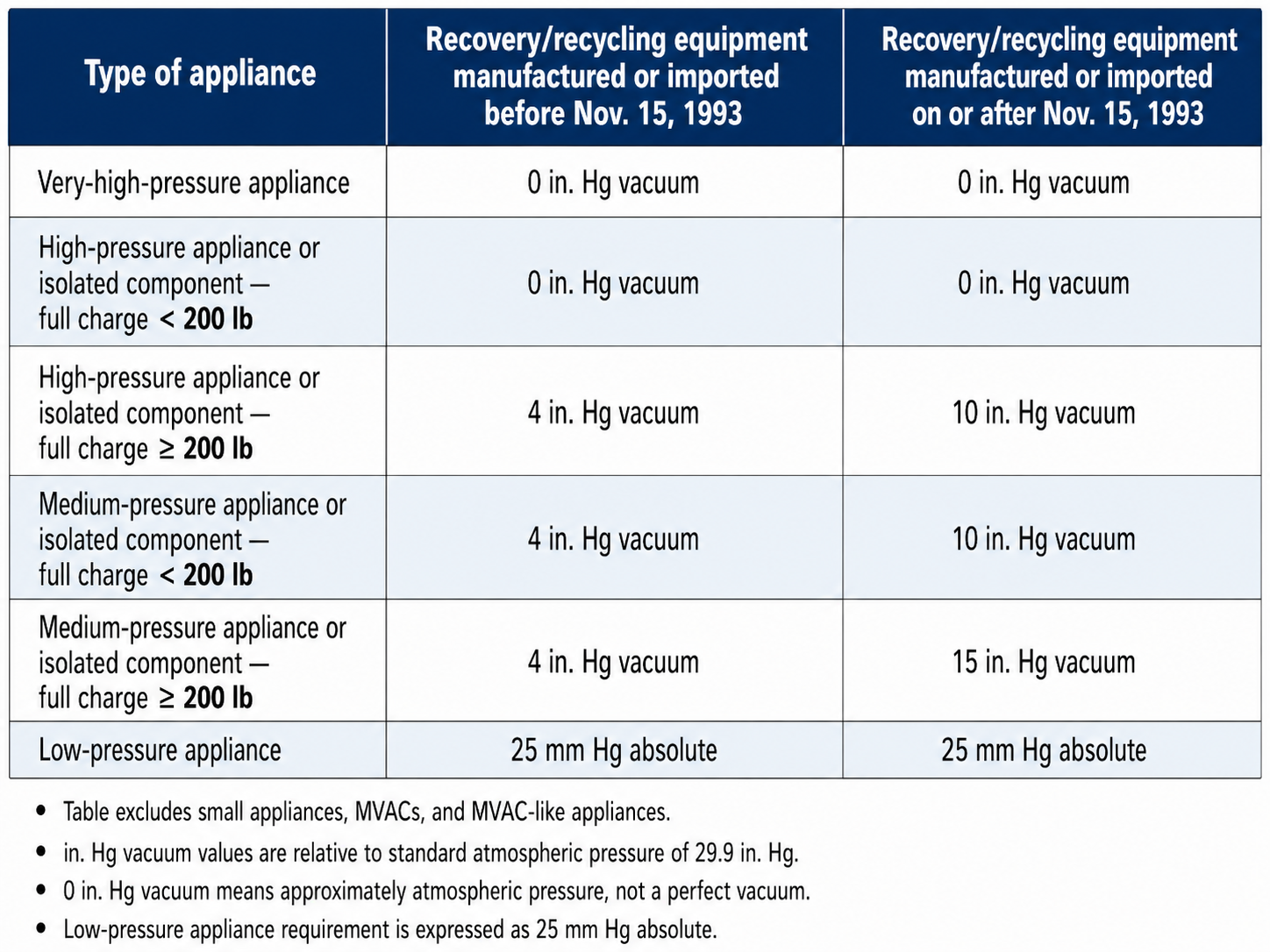
Figure 5.9.1 – Current Section 608 required evacuation levels for appliances other than small appliances, MVACs, and MVAC-like appliances.
AI-generated instructional figure: It may contain visual inaccuracies. Use the accompanying lesson text and cited authoritative sources to verify technical and regulatory details.
EPA 608 Exam Focus
What Students Must Remember
- Refrigerant must be recovered to the applicable required level before a covered appliance or component is opened or disposed of.
- Table 1 excludes:
- Small appliances.
- MVACs.
- MVAC-like appliances.
- A small appliance is not identified by charge alone.
- For Table 1 questions, identify:
- Pressure category.
- Full charge.
- Recovery/recycling equipment manufacture or import date.
- The 1993 date refers to the recovery/recycling equipment, not the appliance.
- Key current Table 1 values using post-1993 equipment are:
- Very high pressure → 0 in. Hg vacuum
- High pressure, <200 lb → 0 in. Hg vacuum
- High pressure, ≥200 lb → 10 in. Hg vacuum
- Medium pressure, <200 lb → 10 in. Hg vacuum
- Medium pressure, ≥200 lb → 15 in. Hg vacuum
- Low pressure → 25 mm Hg absolute
0 in. Hg vacuumdoes not mean perfect vacuum.- Low-pressure appliances use mm Hg absolute, not in. Hg vacuum.
- A major repair includes removal of:
- Compressor.
- Condenser.
- Evaporator.
- Auxiliary heat-exchange coil.
- The major-work definition also includes an opening over 4 in² of flow area for more than 15 minutes.
- A limited non-major exception can allow medium-, high-, and very-high-pressure equipment to be brought to 0 psig before opening when all regulatory conditions are satisfied.
- Low-pressure equipment under that exception is brought to no higher than 0 psig using an allowed pressurization method.
- A leaking appliance does not automatically eliminate the normal evacuation requirement for the entire system.
- When possible:
- Isolate leaking from non-leaking portions.
- Evacuate non-leaking portions to Table 1.
- Evacuate leaking portions to the lowest attainable level without substantial contamination.
- The leaking portion may not remain above 0 psig.
- Refrigerant dissolved in oil can cause pressure rebound after the apparent recovery endpoint is reached.
- Before changing refrigerant oil, the applicable appliance, isolated portion, or receiver must be no higher than 5 psig under the current oil-change provision.
- Disposal of equipment normally dismantled on-site requires refrigerant recovery according to applicable service-practice requirements.
- Disposal recovery from appliances with full charge >5 lb and <50 lb carries a 3-year technician recordkeeping requirement.
High-Priority Evacuation Table
| Appliance | Post-1993 Recovery Equipment |
|---|---|
| Very high pressure | 0 in. Hg vacuum |
| High pressure, <200 lb | 0 in. Hg vacuum |
| High pressure, ≥200 lb | 10 in. Hg vacuum |
| Medium pressure, <200 lb | 10 in. Hg vacuum |
| Medium pressure, ≥200 lb | 15 in. Hg vacuum |
| Low pressure | 25 mm Hg absolute |
High-Priority Exception Memory Aid
NORMAL CASE
→ apply Table 1
LEAK PREVENTS TABLE LEVEL
→ isolate leaking / non-leaking
→ non-leaking to Table 1
→ leaking to lowest attainable
→ not above 0 psig
QUALIFYING NON-MAJOR WORK
→ special 0 psig rule
OIL CHANGE
→ no higher than 5 psig
Typical Exam Question Patterns
Students may be asked to:
- Select the required evacuation level for a high-pressure appliance with less than 200 lb.
- Select the required evacuation level for a high-pressure appliance with 200 lb or more.
- Select the required evacuation level for a medium-pressure appliance with 200 lb or more.
- Identify the low-pressure evacuation requirement.
- Determine whether the 1993 date applies to the appliance or recovery equipment.
- Recognize that 0 in. Hg vacuum is not a perfect vacuum.
- Identify which components make a repair major.
- Identify the 4 in² / 15-minute major-work condition.
- Apply the leak exception.
- Determine what must happen to non-leaking components when another component leaks.
- Identify the special 5 psig oil-change requirement.
- Recognize that refrigerant dissolved in oil can produce pressure rebound.
- Distinguish the main evacuation table from Type I small-appliance recovery requirements.
- Apply the disposal recordkeeping threshold.
Common Mistakes and Confusing Points
Mistake 1: Treating 500 Microns as the Section 608 Table Requirement
Approximately 500 microns is commonly used as a deep-evacuation service benchmark.
It is not the universal Section 608 refrigerant-recovery endpoint.
The Section 608 table uses:
- in. Hg vacuum.
- mm Hg absolute.
Deep evacuation and dehydration are separate technical tasks covered in Sections 5.7 and 5.8.
Mistake 2: Applying the Table to Every Appliance With More Than 5 lb Only
The regulation is organized by appliance category.
A field-connected appliance containing 5 lb or less does not become a small appliance merely because of the charge.
Always apply the complete small-appliance definition.
Mistake 3: Treating November 15, 1993 as the Appliance Manufacture Date
For Table 1, the date distinguishes the recovery/recycling equipment.
It does not classify the refrigeration appliance itself.
Mistake 4: Thinking 0 in. Hg Vacuum Means Perfect Vacuum
On the table’s vacuum scale:
0 in. Hg vacuum
→ atmospheric pressure reference
It does not mean zero absolute pressure.
Mistake 5: Comparing 25 mm Hg Absolute Directly With 15 in. Hg Vacuum
The two values use different pressure references and different units.
Recognize the pressure convention before comparing values.
Mistake 6: Calling Every Compressor-Related Task a Major Repair
The definition concerns removal of specified components or the specified large-opening condition.
A diagnostic measurement on a compressor is not automatically a major repair.
Mistake 7: Assuming Every Non-Major Repair Can Stop at 0 psig
The 0 psig provision is a limited exception with specific conditions.
Non-major status alone is not sufficient.
Mistake 8: Treating an Entire Leaking Appliance as Exempt
The current rule requires isolation of leaking and non-leaking portions wherever possible.
Non-leaking portions still must reach the normal Table 1 level before they are opened or disposed of.
Mistake 9: Using an Older Simplified Statement for Leaking Appliances
Older study material may summarize the leak exception as allowing evacuation only to atmospheric pressure when a leak prevents the prescribed vacuum.
The current rule is more specific:
isolate where possible
→ non-leaking portions to Table 1
→ leaking portion to lowest attainable
→ not above 0 psig
Use the current rule.
Mistake 10: Ignoring Refrigerant Dissolved in Oil
Pressure can rise after an apparent endpoint because refrigerant remains dissolved in oil.
A pressure rebound can mean additional refrigerant recovery is necessary.
Mistake 11: Changing Oil Above 5 psig
The current service-practice provision requires the applicable appliance, isolated portion, or receiver to be no higher than 5 psig before the oil is removed.
Mistake 12: Assuming Disposal Means Refrigerant Requirements End
Disposal is a regulated refrigerant-removal event.
Applicable refrigerant recovery must occur before equipment is dismantled or finally disposed of.
Concept-Check Questions
Question 1
A high-pressure appliance has a full charge of 150 lb. The technician uses recovery equipment manufactured after November 15, 1993. What is the normal required evacuation level before opening the appliance?
A. 0 in. Hg vacuum
B. 4 in. Hg vacuum
C. 10 in. Hg vacuum
D. 15 in. Hg vacuum
Question 2
A high-pressure appliance has a full charge of 250 lb, and post-1993 recovery equipment is used. What is the normal required evacuation level?
A. 0 in. Hg vacuum
B. 4 in. Hg vacuum
C. 10 in. Hg vacuum
D. 25 mm Hg absolute
Question 3
A medium-pressure appliance has a full charge of 300 lb, and post-1993 recovery equipment is used. What is the normal required evacuation level?
A. 0 in. Hg vacuum
B. 10 in. Hg vacuum
C. 15 in. Hg vacuum
D. 25 mm Hg absolute
Question 4
What is the current normal Table 1 evacuation requirement for a low-pressure appliance?
A. 0 psig
B. 4 in. Hg vacuum
C. 15 in. Hg vacuum
D. 25 mm Hg absolute
Question 5
Which activity meets the current federal definition of major maintenance, service, or repair?
A. Attaching a pressure gauge
B. Replacing external pipe insulation
C. Removing an evaporator
D. Tightening a cabinet bolt
Question 6
A leak makes the prescribed Table 1 level unattainable. Which action best matches the current requirement?
A. Stop recovery from the entire appliance at any convenient pressure.
B. Isolate leaking from non-leaking components where possible, evacuate non-leaking components to Table 1, and evacuate leaking components to the lowest attainable level not above 0 psig.
C. Vent the remaining refrigerant because the appliance is leaking.
D. Pressurize every portion of the system above atmospheric pressure.
Question 7
Before changing refrigerant oil under the current Section 608 service-practice provision, the applicable appliance, isolated portion, or receiver must be brought to a pressure no higher than:
A. 0 psia
B. 0 in. Hg absolute
C. 5 psig
D. 15 psig
Question 8
Which statement about the November 15, 1993 date in the main evacuation table is correct?
A. It refers to the date the refrigeration appliance was manufactured.
B. It refers to the manufacture or import date of the recovery/recycling equipment.
C. It applies only to low-pressure appliances.
D. It determines whether a technician needs Section 608 certification.
Answers and detailed explanations will be provided in
5.12 - Answers and Explanations.md.
Section Summary
Section 608 requires refrigerant to be removed to the applicable regulatory level before covered appliances or components are opened or disposed of.
For appliances subject to the main evacuation table, the technician must identify:
pressure category
+
full charge
+
recovery-equipment date
The current post-1993 values are:
Very high pressure
→ 0 in. Hg vacuum
High pressure < 200 lb
→ 0 in. Hg vacuum
High pressure ≥ 200 lb
→ 10 in. Hg vacuum
Medium pressure < 200 lb
→ 10 in. Hg vacuum
Medium pressure ≥ 200 lb
→ 15 in. Hg vacuum
Low pressure
→ 25 mm Hg absolute
Small appliances use separate Type I recovery requirements rather than this table.
The current regulations also contain limited exceptions.
For qualifying non-major work:
special 0 psig provisions may apply
When a leak prevents the prescribed table endpoint:
isolate leaking / non-leaking
→ non-leaking to normal Table 1 level
→ leaking to lowest attainable level
→ not above 0 psig
For refrigerant oil changes:
no higher than 5 psig
before oil removal under the applicable procedure.
Refrigerant can remain dissolved in oil, so pressure rebound after reaching an apparent recovery endpoint can indicate that additional refrigerant remains.
For disposal, refrigerant recovery remains required. Technicians recovering refrigerant for disposal from appliances with a full charge greater than 5 lb and less than 50 lb must retain the specified disposal-recovery records for 3 years.
The next file condenses the complete Module 5 recovery, cylinder, evacuation, and service-practice material into a quick-reference format.
See Section 5.10 - Quick Reference.
References
Current EPA and Regulatory Sources
-
U.S. Environmental Protection Agency, Stationary Refrigeration Service Practice Requirements, accessed August 9, 2026.
-
U.S. Environmental Protection Agency, Required Level of Evacuation of Appliances, accessed August 9, 2026.
-
U.S. Environmental Protection Agency, Section 608 Test Topics, accessed August 9, 2026.
-
U.S. Environmental Protection Agency, Stationary Refrigeration Safe Disposal Requirements, accessed August 9, 2026.
-
U.S. Environmental Protection Agency, Refrigerant Recovery and Recycling Equipment Certification, accessed August 9, 2026.
-
Electronic Code of Federal Regulations, 40 CFR § 82.152 - Definitions, accessed August 9, 2026.
-
Electronic Code of Federal Regulations, 40 CFR § 82.156 - Proper Evacuation of Refrigerant from Appliances, accessed August 9, 2026.